
Achilles pain can be frustrating for runners. It may settle as you warm up, then ache later that day or feel stiff when you first get out of bed. For many people, the instinct is to stop running completely or search for a quick fix. In reality, Achilles tendinopathy treatment usually starts with understanding how much load the tendon is managing and building its capacity gradually.
The most consistently recommended approach is progressive calf and tendon loading, combined with sensible changes to running, footwear and training. The right plan depends on where your pain is, how irritable the tendon is and what may be driving the problem.
Is it Achilles tendonitis or Achilles tendinopathy?
The terms are often used interchangeably, but they are not quite the same.
Achilles tendonitis traditionally suggests inflammation in the tendon. This may be more relevant in the very early stages of an injury, but ongoing Achilles problems are not usually explained by inflammation alone.
Achilles tendinopathy is now the term more commonly used for persistent tendon pain, stiffness and reduced function linked to repeated overload. Put simply, the tendon may be struggling to adapt to the amount or type of load placed on it.
This matters because treatment is not usually about complete rest. Tendons need carefully graded loading to build strength and tolerance again.
Why runners develop Achilles pain
The Achilles tendon connects your calf muscles to your heel bone. It helps transfer force when you walk, climb stairs, push off and run. Running places repeated demand on this area, particularly during faster running, hills, sprinting and jumping.
Achilles pain running may be linked to one issue or a combination of factors, including:
- A rapid increase in mileage, pace, hills or speed sessions
- Returning to running after illness, injury or time away
- Reduced calf strength or endurance
- Changes in footwear, running surface or terrain
- Limited ankle movement or calf stiffness
- Lower-limb loading patterns
- Not enough recovery between harder sessions
- A sudden increase in other activities, such as walking, gym work or court sports
The painful area is not always the full story. A runner may notice symptoms in the tendon, but calf capacity, ankle movement, footwear, training structure and the way the foot and lower limb are loading can all contribute.
Mid-portion vs insertional Achilles tendinopathy
Location matters when planning Achilles tendon rehab.
Mid-portion Achilles tendinopathy
This usually causes pain, tenderness or thickening around 2cm to 7cm above the heel bone. It is the more common pattern in runners.
Insertional Achilles tendinopathy
This affects the point where the tendon attaches to the back of the heel. The area may feel sore when pressed by a shoe and can be more sensitive when the ankle is moved deeply upwards, such as during a calf raise off a step.
Both types can respond to progressive strengthening and load management. However, insertional Achilles tendinopathy often needs a modified starting point. Exercises may initially be performed on flat ground to avoid placing the tendon in a more compressed position against the heel bone.
What actually works for Achilles tendinopathy treatment?
There is no single treatment that suits every runner. However, progressive loading is widely recognised as the central part of treatment for mid-portion Achilles tendinopathy.
This does not mean forcing through increasing pain or following a generic online programme without considering your symptoms. It means gradually exposing the calf and tendon to appropriate levels of resistance, then progressing towards the demands of running.
Clinical guidelines recommend tendon-loading exercise as a first-line approach for people with mid-portion Achilles tendinopathy, provided there is no concern about significant tendon weakness or another injury. A multidisciplinary guideline also recommends progressive calf strengthening for at least 12 weeks alongside education and loading advice.
1. Progressive calf and tendon loading
Calf raises are often a key part of Achilles tendinopathy exercises. Depending on your symptoms and current strength, a rehabilitation plan may progress through stages such as:
- Supported or double-leg calf raises
- Single-leg calf raises
- Heavier slow resistance work
- Faster calf work
- Hopping, jumping or running-specific drills where appropriate
The aim is not simply to perform a certain number of repetitions. It is to improve the tendon and calf’s ability to manage the demands of your running.
The starting point, range of movement and amount of resistance should be matched to your symptoms. Someone with a painful insertional tendon may need a different calf raise position from a runner with mid-portion pain.
2. Load management rather than total rest
Stopping all activity can reduce fitness and calf capacity. Continuing exactly as normal despite worsening symptoms can also make recovery harder.
A more useful approach is often to adjust the load temporarily. This might mean reducing distance, avoiding hills or speed sessions for a period, spacing out harder runs or replacing some running with lower-impact exercise.
The goal is to find a level of activity the tendon can tolerate while you build strength. A symptom-guided plan can help runners monitor their response during activity and the following morning, then adjust the next session accordingly.
3. A gradual return to running
Many runners ask, “Should I keep running with Achilles tendinopathy?”
The answer depends on the severity, location and behaviour of your symptoms. Some people can continue modified running while following a structured strengthening plan. Others may need a more significant reduction in running load for a time.
A return to running should be gradual and based on how the tendon responds, not simply on a calendar date. Before progressing, it is helpful to consider:
- Pain during and after runs
- Morning stiffness the next day
- Calf strength and control
- Tolerance of walking, stairs and calf raises
- Whether symptoms are improving, stable or worsening
- The overall amount of stress from running, gym work, work and daily life
Returning too quickly after symptoms settle can increase the chance of a flare-up. Recovery commonly takes months rather than days, especially if the tendon has been painful for some time.

Do footwear, heel lifts or orthoses help Achilles pain?
Footwear does not cause every Achilles problem, but it can affect how the tendon is loaded.
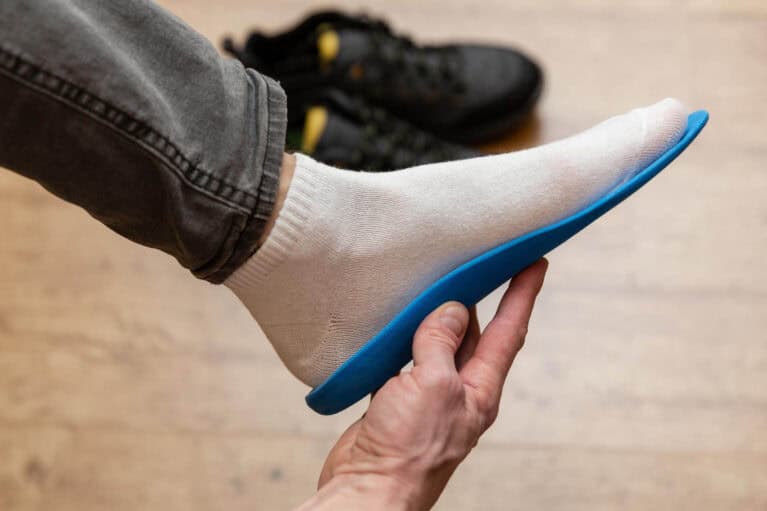
A review may be useful if you have recently changed shoe style, moved to a lower-heeled running shoe, increased hill running or find that the back of your shoe presses on a painful insertion point. In some situations, a temporary heel lift or footwear adjustment may reduce strain or irritation while rehabilitation is underway.
Foot orthoses may also be considered where foot posture or loading patterns appear to be contributing to symptoms. They are not a stand-alone cure and they are not needed for every runner. If recommended, they should form part of a wider plan that includes strengthening, activity management and a staged return to running.
Is gait analysis useful for Achilles tendinopathy?
Gait analysis can be useful when Achilles pain keeps returning, symptoms began after a change in training or footwear, or there are concerns about how the foot and lower limb are managing running loads.
It is more than simply watching someone run. Stuart may assess how your foot lands, how your ankle and calf are working, how your leg moves under load and whether there are patterns that may be placing extra stress on the tendon.
The findings should guide practical next steps. That may include changes to training load, footwear advice, rehabilitation, running technique considerations or orthoses where appropriate.
What about massage, shockwave treatment or injections?
These options may be discussed in some cases, but they should not replace an active loading programme.
If symptoms have not improved after a well-supported period of education, load management and progressive strengthening, further options or referral may be considered. The expected benefits, limitations and risks should be discussed carefully.
An assessment can also help identify whether imaging or onward referral is appropriate. Imaging is not necessary for every case of Achilles pain, particularly where the symptoms and examination findings are clear.
When should you get Achilles pain assessed?
Book an assessment if:
- Pain is affecting your running, walking or daily activity
- Morning stiffness or post-run pain keeps returning
- Your symptoms are worsening despite reducing training
- You cannot perform a controlled calf raise
- The tendon looks more swollen or thickened
- You are unsure how to adapt your running safely
- You have tried rest, stretching or changing shoes without improvement
Seek urgent medical help if you have severe pain after an injury, cannot walk, notice sudden deformity, have spreading redness, fever, pus, a deep wound or signs of infection.
A sudden pop in the back of the ankle, followed by marked weakness or difficulty pushing off, may indicate a more serious injury and needs prompt assessment.
How Stuart can help runners with Achilles tendinopathy
A sports podiatry assessment with Stuart Hodder looks beyond the painful tendon alone. He will discuss your symptoms, running history and recent training changes, then assess your calf function, ankle movement, foot posture, footwear and lower-limb loading.
Where appropriate, this may include gait analysis and discussion of foot orthoses. The aim is to help you understand what may be driving your Achilles pain and build a practical plan for recovery and return to running.
Stuart sees patients in Notting Hill, Wimbledon and Woking, Surrey.
For a fuller overview of symptoms and assessment, visit our Achilles tendinopathy condition page.
FAQs
- What is the best treatment for Achilles tendinopathy?
Progressive calf and tendon loading is generally considered the foundation of treatment for mid-portion Achilles tendinopathy. The most suitable programme depends on your symptoms, tendon location, activity level and assessment findings.
- What exercises help Achilles tendinopathy?
Calf raises are commonly used to gradually build calf and tendon capacity. The correct version, range and resistance will vary between individuals, particularly for insertional Achilles tendinopathy. An assessment can help ensure the exercise plan matches your symptoms.
- How long does Achilles tendinopathy take to heal?
Recovery varies. Symptoms may take several months to settle, especially where the tendon has been painful for a long time. A gradual return to full running is usually more appropriate than trying to resume normal training within days.
- Can I run with Achilles tendinopathy?
Some runners may be able to continue with modified running, while others may need to reduce or pause more demanding activity temporarily. Your symptoms, calf strength and response after running should guide the next step.
- Do orthotics help Achilles pain?
Orthoses may help where foot posture or loading patterns are contributing to the strain on the tendon. They are not necessary for everyone and work best as part of a broader treatment plan where appropriate.
Book an Achilles assessment
If Achilles pain is changing the way you run, walk or train, arrange a sports podiatry appointment with Stuart Hodder. A clear assessment can help you understand what may be driving your symptoms and guide a practical loading plan towards more comfortable movement.
This information is general guidance and does not replace a clinical assessment. If your symptoms are severe, worsening or you are concerned, please seek appropriate medical advice.